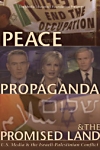
The films starts by presenting the Israeli occupation, showing what Palestinians go through on a daily basis, with violence, checkpoints and curfews. It then goes on to compare the media coverage, showing clips from U.S. news outlets contrasted by British and Israeli coverage of the same stories.
The importance of influencing public opinion in the U.S. is demonstrated in the film by illustrating the pressure exerted on U.S. journalists by pro-Israeli PR campaigns, watchdog groups and lobbyists as well as the sophisticated press offices churning out ready-made stories.
The film lists several PR strategies and shows how these are carried out in the U.S. media. For example, there are strategies to render invisible the occupation and colonization by simply never referring to them as such. Israeli colonies first became "settlements" and are now simply "Jewish neighborhoods." The reversal of the cause and effect is also discussed, with the U.S. media describing the Israeli occupation as a response to suicide bombings and terrorism. And the renaming of the occupation as part of the "global war on terror" is also underlined.
The voice of the Israeli peace movement, which views the occupation as the primary cause of the conflict, is silenced in the U.S. media, which reminded us all of the anti-war movement with regards to Iraq.
During the discussion that followed, the film, while receiving an overall positive reaction, was criticized. Several noted that is was one sided and that it would have been much more powerful had the other side been given at least some space. Others found it lacking in information on the history of the conflict, though we all understand that alone would make for another film, and then some.
We talked about the amount of aid the U.S. gives to Israel, noting the recent request for $2 billion to pay for the withdrawal from Gaza, which was suspended after Katrina, but has now resurfaced with a lesser amount, $1.2 billion.
As there were a number of people from several countries present, those of us from the U.S. tried to impress upon them how taboo this issue is, how difficult it is to talk about it. One person attributed it to how very personal it is for many, while another countered saying that even if you know no one of Jewish faith/culture is anywhere near, you still feel a slight twinge of guilt at even implying that Israel is in the wrong.
We discussed corporate control of the media, as we do at almost all our films, being a fundamental issue. One person criticized the film as not giving any solutions to this control. It was pointed out that the DVD included a PDF file with an enormous number of links to web sites, with everything from alternative media to advocacy groups, both U.S and Israeli based, as well as international. [Download, 300Kb]
When you consider that most U.S. coverage of international issues is, in fact, centered on the Middle East, you realize how important it is to have balanced, accurate information on the conflict in order to understand the role of U.S. foreign policy in the world. This film, though certainly one sided, exposes the spin and helps consumers of U.S. press view the coverage with a more critical eye.
Stephanie Westbrook
Special thanks to Linux Club for their hospitality.
Our Eyes Wide Open Film Series is suspended; for further information click here.
Upshot of our Nov. 9th group discussion on current politics:
It wasn't the Russians that got us Trump. Or Comey. Or even the massive GOP election fraud. It was the DNC.* *Dem National Committee
To learn how to stop the DNC
from delivering us another Trump, read Autopsy: the Democratic Party in Crisis.
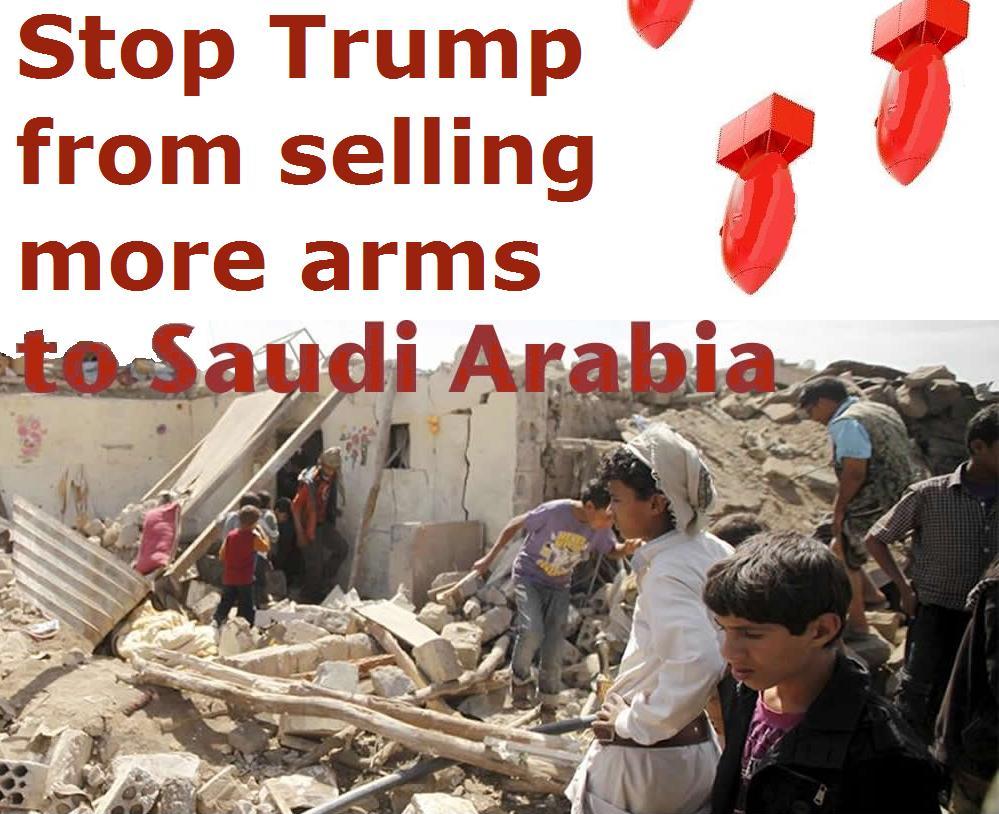
Photo of a school in Yemen bombed by Saudi Arabian jets supplied by the U.S. and fueled in the air by the U.S. Air Force.
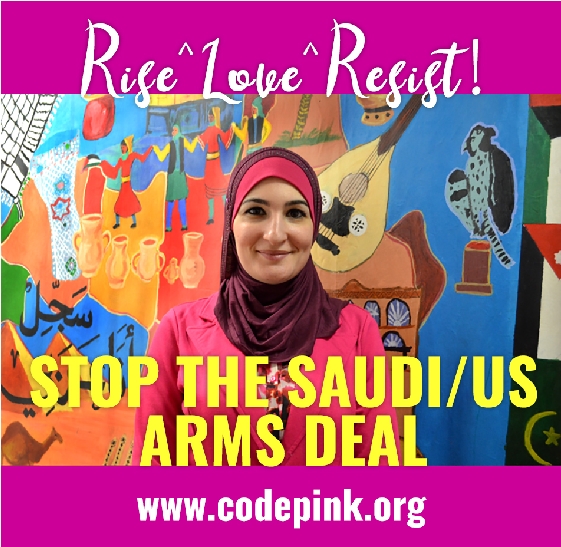
Tell Trump to STOP THIS CARNAGE, not fuel it! Click here.
Also participate in the CodePink email and/or phone initiative:
Click here to sign a petition, to put an end to the sanctions against Syria - their only effect is to take a terrible toll on the population, causing them to migrate! And click here to see the video by the Italian Committee to lift sanctions against Syria.
Did someone tell you that U.S. military intervention in Iraq was over? Not true: we're at it again. This time the pretext to drop bombs is "curbing ISIS" (which was created by the U.S. in the first place, to overturn al-Malaki in Iraq and then Assad in Syria, and is now out of hand.
Like what happened to "our" creature al Qaeda in Afghanistan). And the death toll continues to rise...
Write your senators and tell them: "Enough! U.S. out!! Iraq has shown it can curb ISIS by itself!"
Mailing List
Stay informed
Join the USC4P&J mailing list to stay informed on events and initiatives.