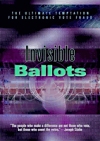
The film starts off with a brief short history of voting, with the concept of the secret ballot and voting systems through the years. It then moved on to HAVA (Help America Vote Act), passed after the 2000 hanging chad fiasco. The blame was incorrectly placed on paper voting in general rather than the faulty system used in Florida. The federal government dangled a carrot in the form of $3 billion for states to renew "outdated" voting systems. This, of course, pleased the 3 biggest companies selling voting systems: Diebold, ES&S and Sequoia.
We learned that these systems have problems throughout, from conflicts of interest such as the case of Senator Chuck Hagel, former chairman of the company that counted an estimated 80% of the votes in his upset election in Nebraska. Hagel still had a substantial financial interest in the company and failed to disclose this information.
We also learned about the very poor programming and security practices of these companies in developing the software for the machines. This was revealed by Diebold itself, who left all their files, for a period of 6 years, on a web server, completely unprotected. The files were found by Bev Harris, investigative reporter and author of the book Black Box Voting. The software was evaluated by computer science experts and found to be full of flaws and lacking in security.
The discussion following the film started off with a question on how elections are conducted in Italy. One of our Italian members explained that you simply mark a paper ballot with a pencil and the ballots are then counted by hand, with persons affiliated with all political parties involved overseeing the count. Even with the hand counting, by around 4am the next morning the results are in. In a 2001 MIT-Caltech study, which evaluated several methods for casting votes, it was found that hand counted paper ballots was the most accurate of all, and in this study, no fraud was involved.
Another issue, redistricting or gerrymandering, which is not covered in the film, was also brought up as it plays a big role in our elections.
We talked about the three reports that have been released since the 2004 elections, the John Conyers report, What Went Wrong in Ohio, the controversial Baker Carter Commission report, which calls for a national ID card, though there is no evidence of widespread voter ID fraud, and the recent report from the Government Accountability Office, which was lauded by both Republicans and Democrats and referred to as a "wake up call", but unfortunately got no press coverage at all.
We wound up by talking about current legislation to support, such as HR 550 calling for a Voter Verified Paper Ballot, so that voters can vote electronically yet still verify the proper results were recorded on paper. Random recounts would be held to determine if the paper and machine counts matched. In the event they do not, the paper ballot would be the official record.
There is a similar bill that should be defeated, HR 3910, which would leave it up to the states to determine which record of the vote, paper or machine, is the official record. [Take action!]
We had a full house and a very interesting discussion. One thing many of us agreed on, aside from the need for election reforms, was that we were quite impressed by Bev Harris!
Stephanie Westbrook
Special thanks to Linux Club for their hospitality.
Our Eyes Wide Open Film Series is suspended; for further information click here.
Upshot of our Nov. 9th group discussion on current politics:
It wasn't the Russians that got us Trump. Or Comey. Or even the massive GOP election fraud. It was the DNC.* *Dem National Committee
To learn how to stop the DNC
from delivering us another Trump, read Autopsy: the Democratic Party in Crisis.
Photo of a school in Yemen bombed by Saudi Arabian jets supplied by the U.S. and fueled in the air by the U.S. Air Force.
Tell Trump to STOP THIS CARNAGE, not fuel it! Click here.
Also participate in the CodePink email and/or phone initiative:
Click here to sign a petition, to put an end to the sanctions against Syria - their only effect is to take a terrible toll on the population, causing them to migrate! And click here to see the video by the Italian Committee to lift sanctions against Syria.
Did someone tell you that U.S. military intervention in Iraq was over? Not true: we're at it again. This time the pretext to drop bombs is "curbing ISIS" (which was created by the U.S. in the first place, to overturn al-Malaki in Iraq and then Assad in Syria, and is now out of hand.
Like what happened to "our" creature al Qaeda in Afghanistan). And the death toll continues to rise...
Write your senators and tell them: "Enough! U.S. out!! Iraq has shown it can curb ISIS by itself!"
Mailing List
Stay informed
Join the USC4P&J mailing list to stay informed on events and initiatives.