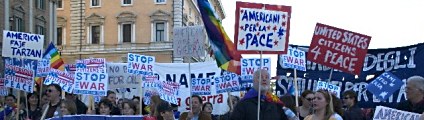
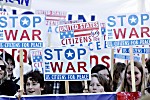
To mark the second anniversary of the invasion of Iraq, an estimated 100,000 people marched in Rome on March 19, demanding an immediate end to the Iraqi war and the withdrawal of Italian and other occupation troops. The event also recognized Iraq’s right to resist its occupation, and called for the removal of US and NATO military bases from Italy.
The protest was one of thousands held that day across the globe in over 40 countries as well as in 765 American communities. According to the Department of Defense, as of April 29, 2005, 1,574 American military have died in the conflict; another 12,147 have been wounded. And a study published in the British medical journal, The Lancet, last year, reported that the deaths of over 100,000 Iraqi civilians—mostly women and children—are directly attributable to the war. [www.thelancet.com; The Lancet 2004; 364:1857-1864]
In the enthusiastic crowd were more than 50 US citizens, mostly ex-pats from Rome and a group from U.S. Citizens Against War (Florence), bearing red, white, and blue signs and a banner held aloft by a group of children. Watchers shouted support from sidewalks and windows along the route, which left Piazza della Repubblica for via Cavour before veering onto via dei Fori Imperiali. As marchers approached Piazza Venezia, they were applauded by the crowd, which included many US tourists. Although the march had been entirely peaceful, a minor scuffle at the far side of the piazza unsettled marchers, when some demonstrators apparently attempted to break through a formidable line of riot gear-clad police. Their attempt to march to Prime Minister Silvio Berlusconi's offices in Palazzo Chigi was rebuffed.
Some marchers, especially those with children, disbanded at this point; there was some confusion in the ranks as to whether or not the protest would continue to its original destination, Piazza Navona. But continue it finally did, led by a sound truck blaring music and anti-war slogans. From time to time, spontaneous singing and chanting erupted as the group marched down via Corso Vittorio Emanuele. Once at Piazza Navona, the crowds thinned and eventually dispersed, though the police maintained a presence in the piazza, controlling many of the entrances, for several hours.
Press coverage of the event included the Associated Press, ABC News, Voice of America, and CBS News.
Sara Altshul
Ongoing/Future Events
Our Eyes Wide Open Film Series is suspended; for further information click here.
Upshot of our Nov. 9th group discussion on current politics:
It wasn't the Russians that got us Trump. Or Comey. Or even the massive GOP election fraud. It was the DNC.* *Dem National Committee
To learn how to stop the DNC
from delivering us another Trump, read Autopsy: the Democratic Party in Crisis.
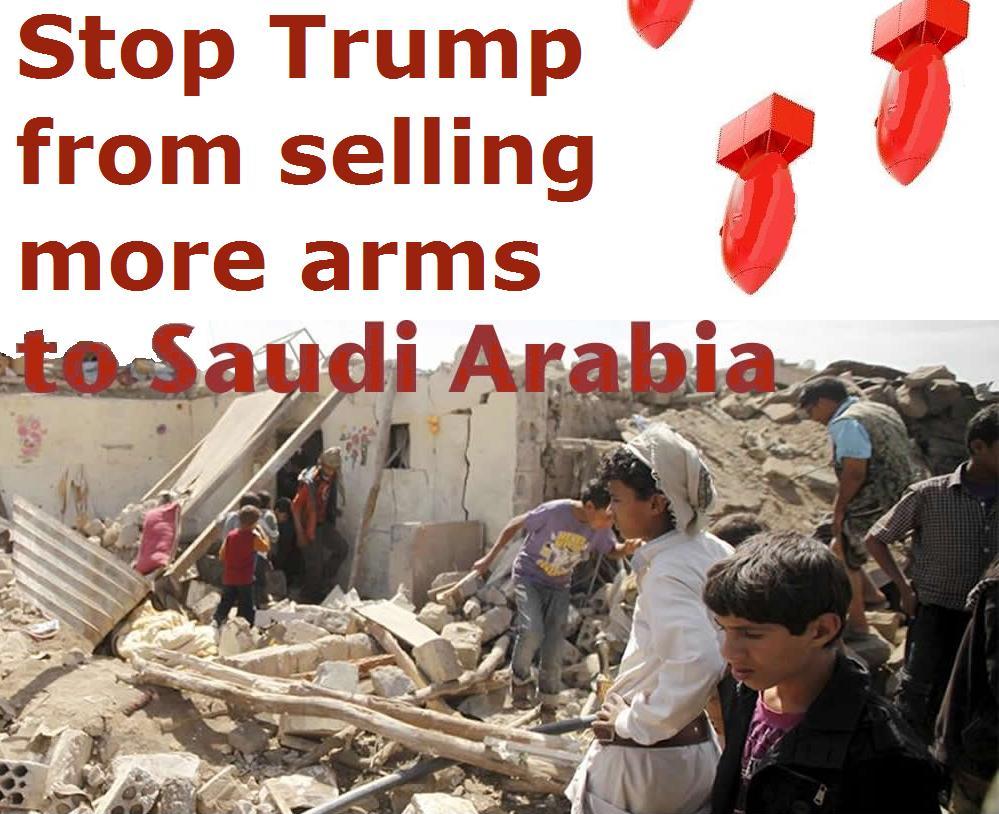
Photo of a school in Yemen bombed by Saudi Arabian jets supplied by the U.S. and fueled in the air by the U.S. Air Force.
Tell Trump to STOP THIS CARNAGE, not fuel it! Click here.
Also participate in the CodePink email and/or phone initiative:
Click here to sign a petition, to put an end to the sanctions against Syria - their only effect is to take a terrible toll on the population, causing them to migrate! And click here to see the video by the Italian Committee to lift sanctions against Syria.
Did someone tell you that U.S. military intervention in Iraq was over? Not true: we're at it again. This time the pretext to drop bombs is "curbing ISIS" (which was created by the U.S. in the first place, to overturn al-Malaki in Iraq and then Assad in Syria, and is now out of hand.
Like what happened to "our" creature al Qaeda in Afghanistan). And the death toll continues to rise...
Write your senators and tell them: "Enough! U.S. out!! Iraq has shown it can curb ISIS by itself!"
Mailing List
Stay informed
Join the USC4P&J mailing list to stay informed on events and initiatives.